
Language: Deutsch · English
A fault report alone does not make an actionable maintenance process. The unique asset identifier, affected order or current maintenance history may still be missing. As long as employees have to assemble this information manually, the value of an AI assistant remains limited. Industrial AI needs reliable handovers between the systems where work is planned, performed and documented.
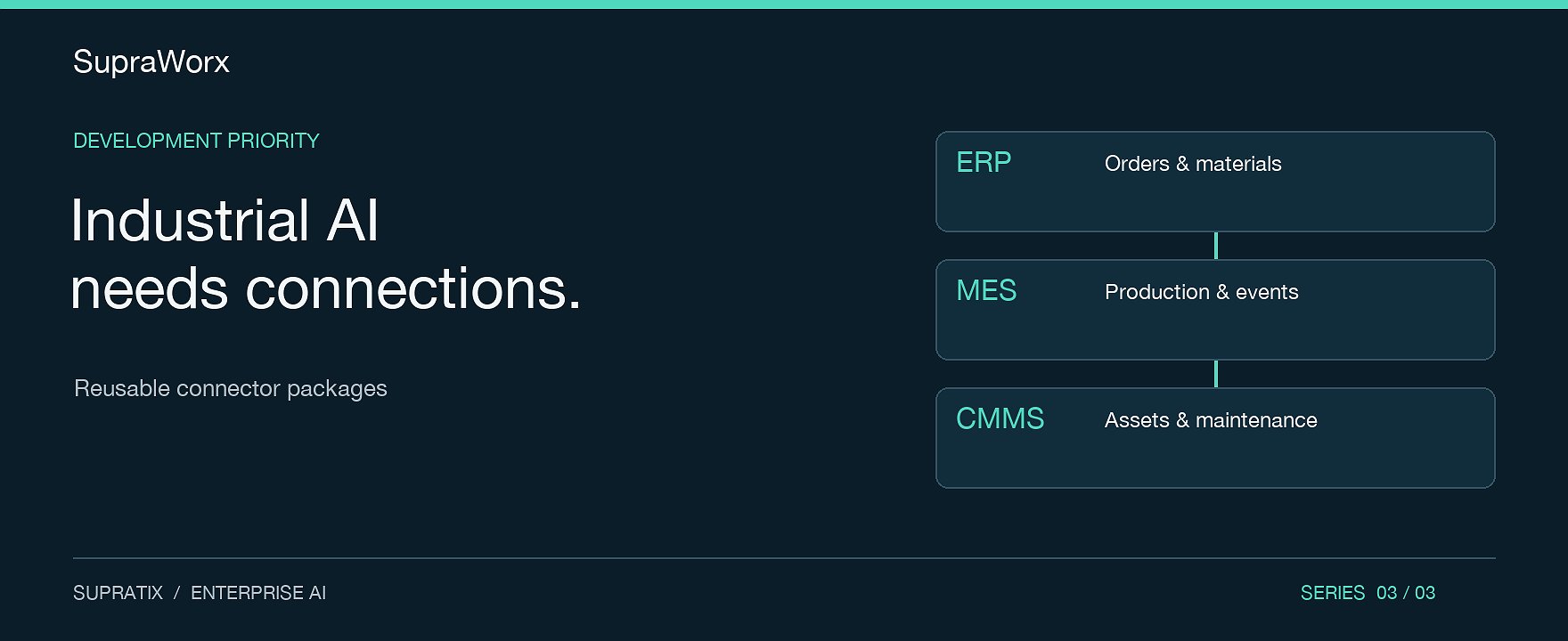
At this intersection, SupraWorx can be positioned as a platform for an Industrial AI Workforce, connecting knowledge with defined workflows and controlled actions. Standardised ERP, MES and CMMS connector packages are therefore a major development priority. The packages below describe priorities and a target architecture; they do not claim general product availability for specific vendors or versions.
Three system domains, one business context
ERP systems typically bring together commercial and logistics information, including orders, materials and inventory. MES systems support production management and documentation. CMMS systems organise maintenance through assets, notifications and work orders. The exact allocation of these functions varies between businesses.
Good integration therefore starts with shared definitions. What identifies an asset? Which system owns the order? How are statuses and timestamps interpreted? Without this mapping, even a technically successful transfer can end up in the wrong case.
The existing foundation: API Gateway and process components
A general integration foundation is publicly described for SupraWorx. The API Gateway supports multiple interface standards, while Shortcuts can automate subsequent steps. The publication mentions exchanging planning, inventory and invoice information. This establishes a basis for integration work, rather than blanket certification of a particular ERP, MES or CMMS product. Source: Connecting external systems with SupraWorx.
The public SupraWorx architecture also connects data context, agents and bounded interface actions. This is relevant to industrial applications: an analysis should belong to an identifiable case, and its follow-up action should remain traceable. Source: SupraWorx and industrial AI.
Prioritise connector packages around a complete process
Proposed package | Useful initial scope | Evidence required before production writes |
|---|---|---|
ERP order and material context | Provide read access to selected orders, material references and statuses. | Unambiguous mapping, data freshness and documented master-data ownership. |
MES events and production context | Receive defined events and order references. | Correct ordering, timestamps and handling of late or duplicate events. |
CMMS notifications and work orders | Read maintenance history and initially prepare a proposed work order. | Authorised approval, duplicate prevention and verifiable confirmation from the target system. |
This sequence is a starting hypothesis. Priority goes to the combination that completes a relevant business process with reasonable effort. Vendor, version, deployment model, API availability and actual demand determine which adapters to select.
Example: from a fault report to an approved work order
In an illustrative target process, production reports a recurring deviation. The MES supplies the event and order reference. An ERP connection adds the related material context. A CMMS connection retrieves the maintenance history for the affected asset. SupraWorx uses this information to prepare a reasoned maintenance proposal.
If the asset cannot be identified unambiguously, the case goes for clarification. Once the required information is available, an authorised person reviews the proposal. Only then does a narrowly scoped action create the work order. The response includes the external case identifier and actual status. If the target system does not respond, the workflow must first establish the outcome before attempting another write.
The example also illustrates the boundary with machine control: an approved maintenance work order does not replace the safety authorisation required for a machine.
Standardisation must include operations
A reusable package includes the adapter, field mapping, a workflow template and clear operating instructions. It also specifies supported versions, required permissions, known limitations and accountable support. Package status should distinguish development, pilot and production approval.
Acceptance testing covers normal cases and deliberate failures: missing master data, denied permissions, a target-system outage and duplicate delivery. Measure processing time, manual corrections, complete case mapping and successful handovers. These metrics provide the basis for a scaling decision.
Your next step: Choose one concrete handover between production, planning and maintenance. Record the systems, versions and desired actions involved. Define the first connector pilot with SupraTix.


