Öffentlich
Es sind noch 0 von None Plätzen verfügbar.


Culture gives structure to all the different opinions, feelings and actions from the people around the world (Hofstede, 2006, p. 2 ff). According to Hofstede, culture forms the way people think, feel and act in the early childhood years. He uses the metaphor mental programming to express, that cultural learnt behaviors are shown in an highly consistent manner. They are socially learnt in the family, kindergarten, working place or peer group. Like social environments can differ highly, mental programs can differ highly too. Therefore culture is always taken as a collective phenomena because you unintentional share social environments and its norms with other social beings. Culture comprends e. g. greeting systems, food and beverages, handling emotions and physical distance, sex and hygiene.
For Hofstede (2006, p. 4) the mental programming can be divided into three layers: Personality, culture and human nature. Culture is learnt and not inherited and should be considered separately from human nature and personality. Human nature is inherited and describes all the characteristics which are summarized in every human being, like the basic emotions or the need for social interaction. Personality is learnt and inherited at the same time. The personality describes the individual mental program of every person and is based on the character traits. Although the layers are regarded separately there is still discussion going on where exactly the borders are. The following image sums the different layers up.
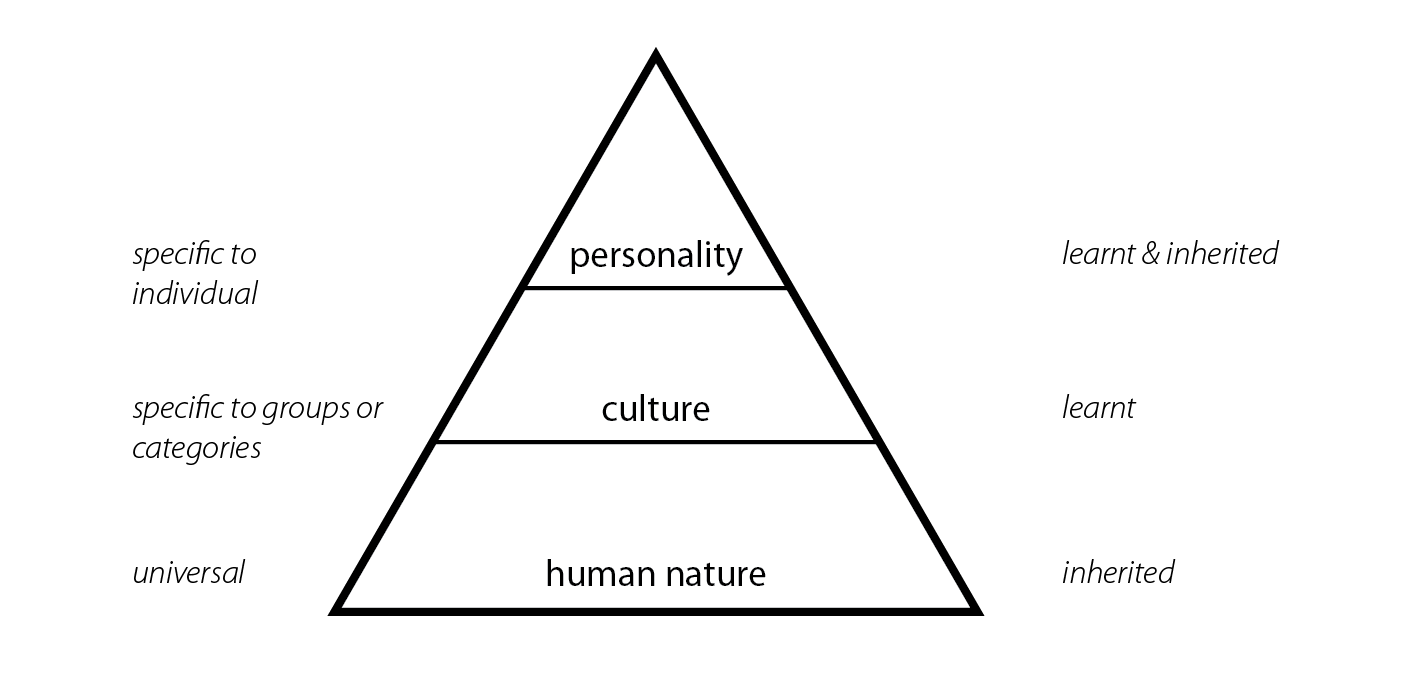
The different levels of uniqueness according to Hofstede (2006)
Hofstede furthermore stresses the importance of a neutral approach to culture (Hofstede, 2006, p. 6), calledcultural relativism. The cultural relativism states that no cultural norm is transferable to other cultures and therefore cultures are not judgeable in the meaning that some cultures are better or worst than others, they are simply different. People in contact to other cultures should be headful with fast token prejudices. There is no scientific and objective way to judge a person's feelings, opinions and actions. Nevertheless tendencies exist to display different cultures in a superior or inferior way. Historical examples like colonisation show the consequences of the general treatment and understanding of “inferior cultures”. Further historical examples are: the ideology of the own superiority of the German race during the second world war resulting in the legitimate destruction of other cultures and “races” (Hofstede, 2006, p. 5) or the structured erasement of indigenous population during the conquest of the desert in Argentina (Cresto, 2004).
According to Hofstede (2006, p. 7 ff) cultural differences manifest in symbols, heroes, rituals and values. He uses the metaphor to an onion, indicating that the values are the most resistant and inner lying and the symbols the rather superficial manifestations of culture. Symbols consist of words, gestes, images and objects which contain a meaning e.g. technical language, clothes, flags or symbols of status. Because of its inconsistent way of handling symbols e.g. the changes of fashion trends and the adoption of language, symbols are presented by the paring of the onion. Heroes displaying characteristics, which are highly respected in a culture and are used as idols. Examples are Batman, Barbie or Asterix. Rituals are collective activities, which are not necessarily useful to gain a goal but are performed for their own inlying reasons, like the way people greet each other or social and religious ceremonies. Rituals unify the members of a culture and give them the opportunity to show themselves. Symbols, heroes and rituals are summarized as practice since they are somehow observable. Values are the core of the onion and not directly observable. Values are general disposition to prefere or refuse special situations. Therefore values consist of orientations towards feelings like good and bad, dirty and clean, forbidden and allowed, natural and unnatural or ugly and beautiful. Throughout different cultures exist very different understandings of what is e.g. beautiful or natural.
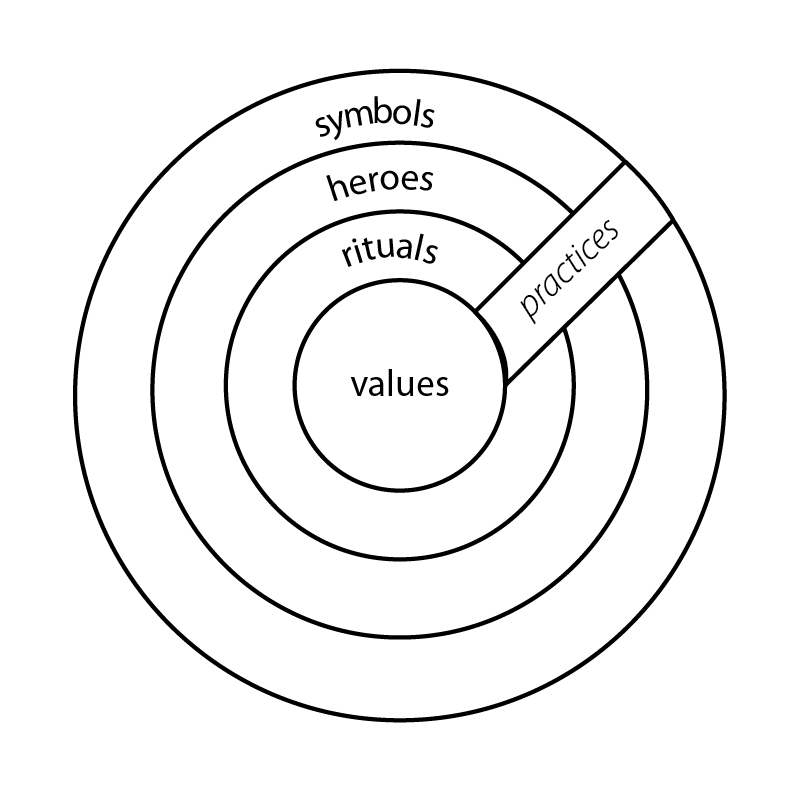 The different manifestations of culture according to Hofstede (2006)
Human children absorb their surrounding for ten to twelfth years more or less unconsciously. After the twelfth year humans tend to learn in a more active and conscious way. In the early years children learn to know what is important in live – the values, but as well the language, heroes and rituals.
Culture reproduces itself by the transition from the parents to their children. Children are value-formed by the way the parents interact with them, how they are treated, how the surrounding comports, how the surrounding acts as the child cries. In these years the children’s heroes are the parents and they try to be like them. Thereby they learn how to act in the right way and what is wrong and what happens if they do something forbidden. During the years of the kindergarten and primary school, the manifestation of culture opens to peers and other authorities e.g. teachers as the parents. In this period they learn how to make friends, interact in hierarchies and how to behave in a socially accepted manner. In the teenage years the individual focus is even more on the peer group and results in finding its own identity. In the years after school the individual meets, culturally formed and influenced, a mate. After having children the process starts again. Scientist call this phenomena homeostasis. Homeostasis describes the maintenance of an open and dynamic systems through an internal regulating process. In this case the reproduction of culture from one generation to the next.
There exist different levels of cultural programming since every individual takes part in different groups and categories. The levels are organised in a general to a more specific layer (Hofstede, 2006, p. 12):
national level, depending in which country or countries the individual lives
regional, ethical, religious or linguistic level, depending on existing regional, ethical, religious or linguistic groups in a country
the level of gender, depending if the individual is born as a boy or a girl
the level of generation, differentiating e.g. between grandparents, parents and children
the social class level, in connection to e.g. (educational) possibilities and work
the organisational level, specifying the place where the individual works and is being socialized
These different programmings are unified in every individual and sometimes contradictory, e.g. the religious values against modern societal values or gender questions in relation to organisational values. These different programmings make it furthermore difficult to anticipate the comportment of an individual in a situation since the person can react in either the one as well as the other level.
Hofstede takes culture as stable and not changeable (2006, p. 13). Although changes are noticed every day in families, at work and in the society, the Cola drinking teenanger will not change his opinion about e.g. authorities just because of international consumer goods. The changes between generations may be the same between different cultures, there is no evidence for value approximations. It is more likely, that the outer layer of the onion changes e.g. symbols, heroes and rituals (=practices) but not the deeper layers e.g. values. The individual learns practices throughout its whole life, therefore our grandpa learns how to use the internet or a smartphone. It is very difficult to change the values of a culture based on their stability. Since values are learnt in the first years of our lives. There are also differences among values. Values regarding gender, the national and regional level are highly stable. Values, which are learnt later in life, e.g. organisational values, are easier to change. Another reason because values are so consistent contains the rules of the so called social game. While technologies are changing and more and more innovative products are published, the changes regarding social interaction stayed more the same: working to make money, to impress other people, to find a mate, ... the base stays the same, just the surface changes.
Session wird geladen ...
Viewer: 0