When selecting AI agents for a factory, consider the complete path to the work outcome. Where does the data come from? Where is it processed? How does the system identify the correct asset context? And which authority decides whether an action may proceed?
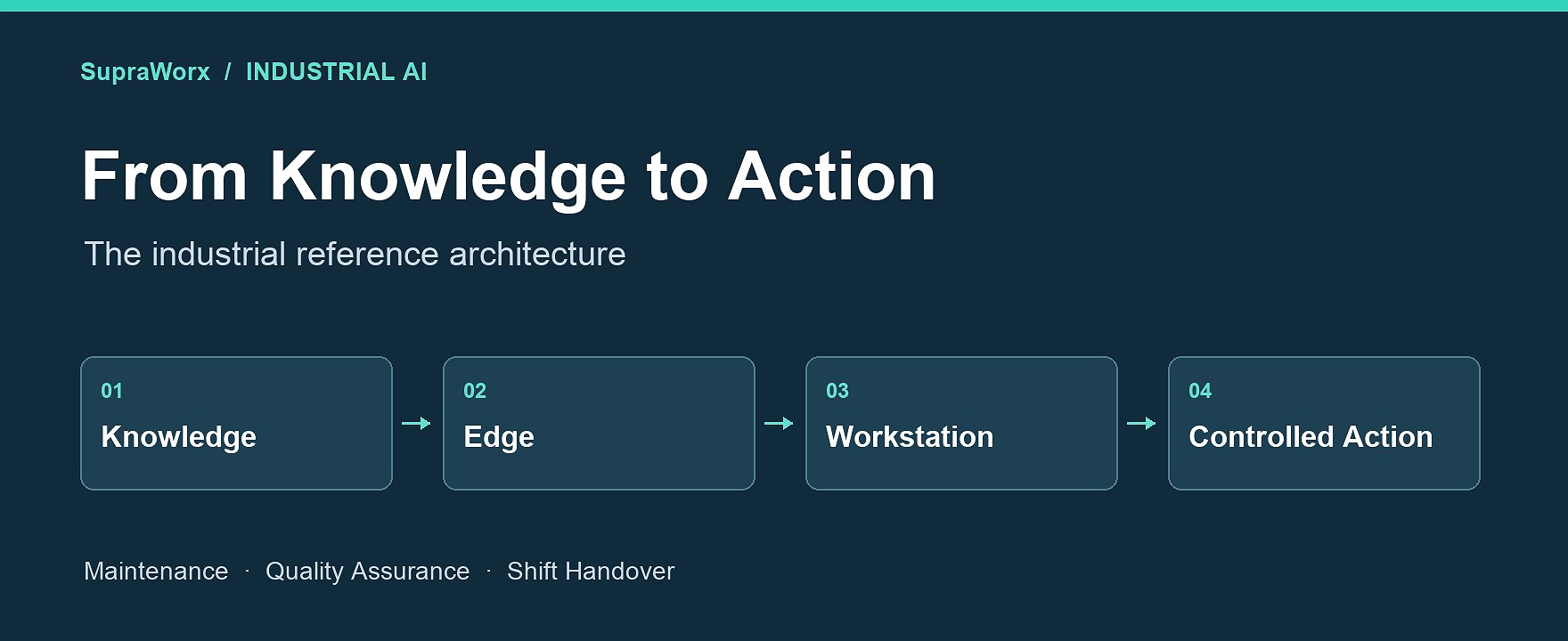
For SupraWorx as an Industrial AI Workforce / Physical AI for the Factory, the reference chain is: Knowledge → Edge → Machine/Workstation → Controlled Action. The following comparison architecture makes this perspective publicly understandable. It describes architecture types and assessment requirements; it is not a performance test of individual vendors.
Two architectural starting points
A horizontal cloud agent typically starts with a task and uses digital tools to research information, edit documents or create a record in a connected application. This can also be valuable in industrial companies. Deployment directly on the shop floor adds questions about the local environment, asset connectivity and failure behaviour.
The industrial SupraWorx perspective therefore starts with the complete work process. The specific capabilities available must be checked for each installation. Cloud agents can also integrate edge systems and industrial interfaces. The distinction lies in demonstrating the complete chain.
Assessment question | Horizontal cloud agent: typical starting point | SupraWorx: industrial reference architecture |
|---|---|---|
What defines the context? | Task, documents and connected applications | Additionally: asset, workstation, work order and process rule |
Where does processing run? | Centrally provided agent and model services | A task-appropriate combination of edge and central services |
How is the physical environment connected? | Through additional integrations | Devices, data and workstations are an explicit part of the project scope |
What authorises an action? | Tool permissions and configured rules | Additionally: verified asset state and application-specific approvals |
How is suitability demonstrated? | Successful completion of digital tasks | Evidence of process quality, operational behaviour and permitted responses in the factory |
1. Knowledge: which foundation is valid?
Execution starts with the technical basis. A maintenance instruction must match the correct unit and current revision. An inspection characteristic must be assigned to the specific component. Project assessment therefore begins with source ownership, document versions and access rights.
Through AI Workbench and SupraAgent, SupraWorx describes the connection between information processing and downstream workflows. One documented example is processing scanned inspection reports (German). A subject matter review remains part of that process before results enter downstream workflows.
2. Edge: which processing must happen on site?
For each data stream, decide whether local processing is required. Relevant factors include response time, network availability, data volume and operational permission to share data. Record these requirements as testable criteria for the pilot.
A useful failure test interrupts connectivity during an active workflow. Define expected behaviour beforehand: Which information remains available? Which task waits? Which action is cancelled? Edge deployment alone does not demonstrate complete offline capability.
3. Machine and workstation: is the context unambiguous?
“Asset three” can refer to different machines in different halls. A dependable implementation needs unique identifiers and confirmation when ambiguity arises. Also check timestamps, data quality and the permissions of the person acting.
For data exchange, SupraTix describes an API Gateway for connecting external systems (German). This is not a blanket promise of compatibility with every machine: the specific interface and its permitted operations are part of the integration.
4. Controlled action: what was actually executed?
A proposed action needs a clear status. “Prepared”, “approved” and “executed” must remain distinguishable. A robust acceptance test also checks duplicate execution, expired approvals and missing responses. Success should only be reported once the target system confirms it.
The SupraWorx edge architecture (German) describes bounded action interfaces and an independent safety boundary around machine control.
The decisive question for your selection
Ask for a demonstration of a representative workflow, including a failure case: from the source through local processing to a confirmed action. This reveals whether the solution fits your factory.
SupraWorx positions itself as an Industrial AI Workforce along this complete chain. Review the reference architecture for a specific workstation with SupraTix.