
A service experience may be useful today and lose its applicability after a machine modification. It may be blocked from operational use while still being needed as evidence for a limited period. A responsible knowledge lifecycle must distinguish these states.
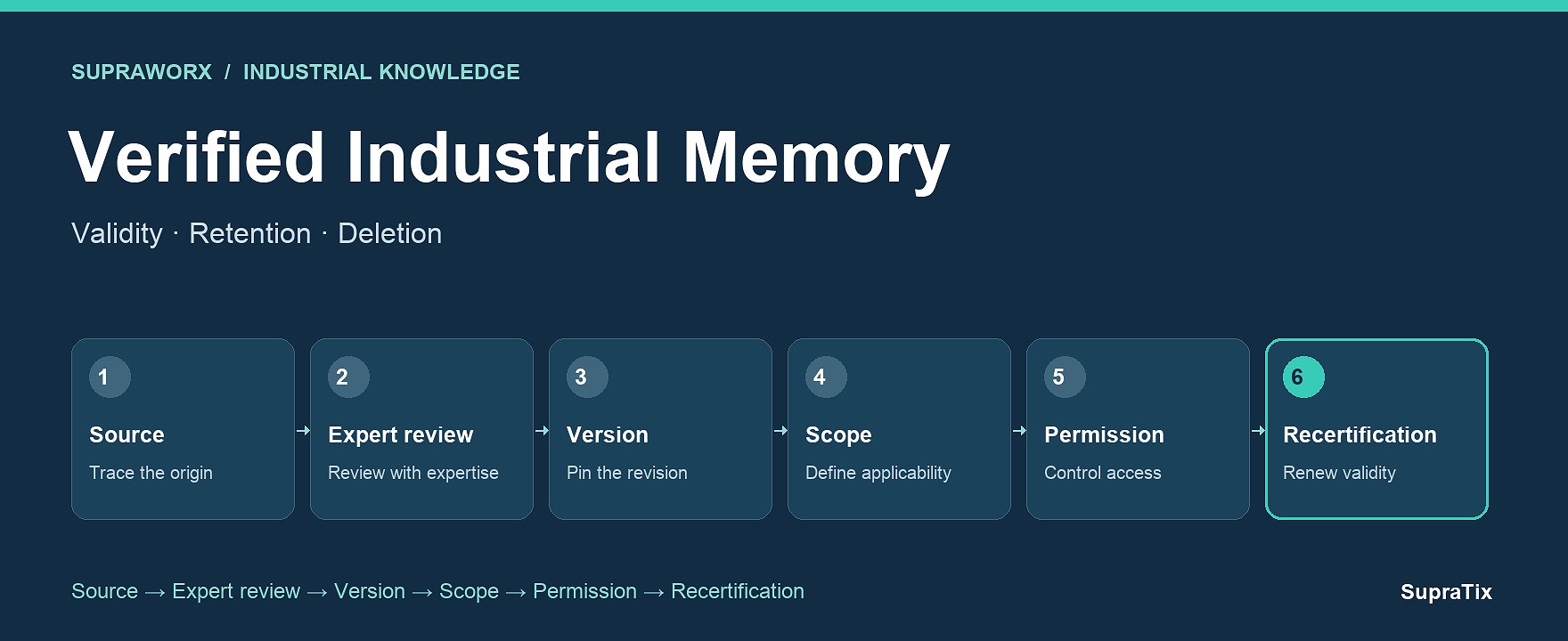
Verified Industrial Memory connects the existing SupraWorx principle in a clear chain: Source → Expert review → Version → Scope → Permission → Recertification. The final link ensures that previously reviewed knowledge is not reused indefinitely without reassessment.
Validity ends independently of storage
“Still stored” does not establish current usability. A knowledge entry can lose validity because a deadline has been reached, a source has changed or a relevant permission is missing. A connected application must treat the entry accordingly from that point onward.
A fresh review determines whether the statement remains sound, needs a narrower scope or should be replaced by a new revision. Recertification requires a concrete expert decision. An automated reminder or a successful background check of the data structure is not sufficient on its own.
Three deadlines with different purposes
The new knowledge extension provides three explicitly defined deadlines. The validity deadline limits operational use. The content retention deadline determines how long the actual knowledge content should remain stored. The audit retention deadline limits subsequent storage of the remaining review metadata.
These deadlines are defined for each use case. There is no universal period that fits every type of industrial knowledge. The ordering required by the code prevents contradictory policies: Content retention cannot end before the specified validity period, and audit retention cannot end before content retention.
Retirement and deletion remain distinct
When an entry is retired, its operational usability ends. Its content can initially remain stored where the defined retention policy requires that. After the content retention deadline, an explicitly requested disposal step can remove the text and source references. Limited metadata then continues to document the lifecycle.
After the audit retention deadline, the extension provides a separate full removal step. A legal hold prevents either disposal stage. This makes an important operational decision expressible in software: Expired validity does not always mean immediate deletion, and retained information is not automatically authorized for continued use.
Automation needs clear boundaries
The revalidation Shortcut marks affected knowledge entries as requiring review. It does not extend validity, grant expert approval or perform deletion. Retention and disposal remain separate operations requiring explicit permissions. This extension does not automatically prune existing SOP histories.
The additional rules described here are implemented as a code extension under mint/shortcuts. Before use in a particular environment, the migration, roles, deadlines and integrations must be configured and checked. The lifecycle is therefore a reviewable implementation scope, rather than a claim of an already completed platform-wide rollout.
What the organization should define
A sound starting point identifies the knowledge owner, the expert reviewing role, relevant change events and the parties responsible for retention and disposal. Expiry, retirement and source changes can then be tested in practice.
Verified Industrial Memory protects the value of experience: usable while its conditions remain valid, traceable during the required retention period and removable according to the defined rules.
Design the lifecycle of your reviewed operational knowledge with SupraTix.


