“When a fault is reported on line two, identify the asset, ask for missing details and prepare a maintenance work order. The shift supervisor should confirm it before handoff.” This is how people describe their work. An accessible workflow builder should translate that description into a process that subject matter experts can understand and review.
For SupraWorx as an Industrial AI Workforce / Physical AI for the Factory, this is a clear vision: describe industrial workflows in everyday language, then configure them in a controlled way. Ease of use comes from letting people express their intent directly while showing what the system makes of it.
Scope: This article describes a product and application concept. It does not announce a generally available Industrial Workflow Builder or already released standard agents. Availability, specific capabilities and integrations must be clarified with SupraTix before deployment.
Turn a spoken request into a readable process
A voice-based Industrial Workflow Builder should first show a draft after receiving the instruction. It contains triggers, required fields, data sources, decision rules, responsible roles and permitted actions. Missing information appears as follow-up questions. Only after review does the draft become a configuration that can be activated.
The example instruction leaves three particular questions open: Which asset does “line two” mean? What information does maintenance need? And what should happen if the shift supervisor cannot be reached? A good draft exposes these gaps before a workflow goes live.
Template 1: maintenance – from observation to reviewed work order
A possible template starts with a voice report at the workstation. It captures the asset identifier, fault description, time and actions already taken. Suspected causes are explicitly labelled as assumptions. Missing mandatory information is requested.
The result is a draft work order with supporting evidence and a named reviewing role. Transfer to a maintenance system takes place only after the required approval and through an established interface. An unsuccessful transfer attempt must remain visible.
A related approach already described publicly is voice-based service documentation with SpeakSphere (German). It suggests a useful starting point: first measure draft ticket quality and the remaining correction effort.
Template 2: quality assurance – capture deviations completely
A QA template could link a spoken observation to a component, batch, inspection characteristic and measured value. The draft distinguishes observation, measurement and assessment. When an assignment is unclear, the system asks rather than assumes a connection.
The responsible quality role decides what happens next. An inspection order, a repeat measurement and a decision to place a batch on hold are modelled as separate steps with their own permissions. A practical pilot metric is the proportion of deviation reports that can be processed without further clarification.
Template 3: shift handover – transfer open work with responsibility
For shift handover, a template should prepare a structured overview from reports and confirmed records: What is complete? What remains open? What is the deadline? Who takes ownership? Unconfirmed information receives a recognisable status.
The incoming shift reviews the overview and confirms responsibility for open items. In multilingual teams, technical terms and asset identifiers belong in the quality check. A translation that sounds fluent is not sufficient for a reliable handover.
Simple operation, traceable approval
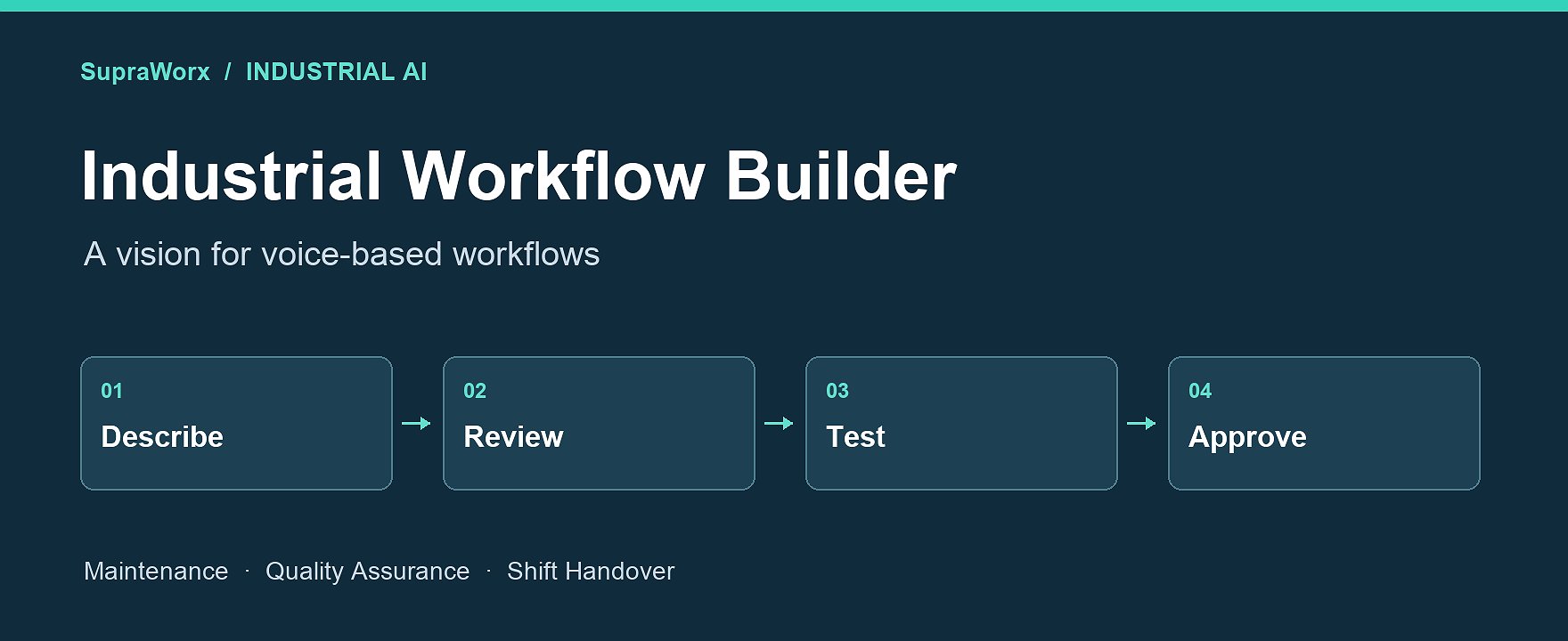
The concept should provide four visible steps: Describe → Review the draft → Test with examples → Approve. Test runs do not trigger production machine or system actions. Subject matter experts check normal cases, incomplete inputs and exceptions.
Workflow changes require a recognisable version. For every execution, the input, confirmed interpretation, approval and result should remain traceable. Machine actions additionally require application-specific technical qualification and independent protective functions.
Turn the vision into a useful pilot
Choose one of the three tasks and limit the scope to a workstation or process. Establish baselines for processing time, completeness and corrections. Then use real cases to determine whether the workflow has become easier to understand and more reliable.
The ambition remains concrete: the Industrial AI Workforce should reflect the language of people in the factory and make actions verifiable. Discuss your use case and the available implementation scope with SupraTix.