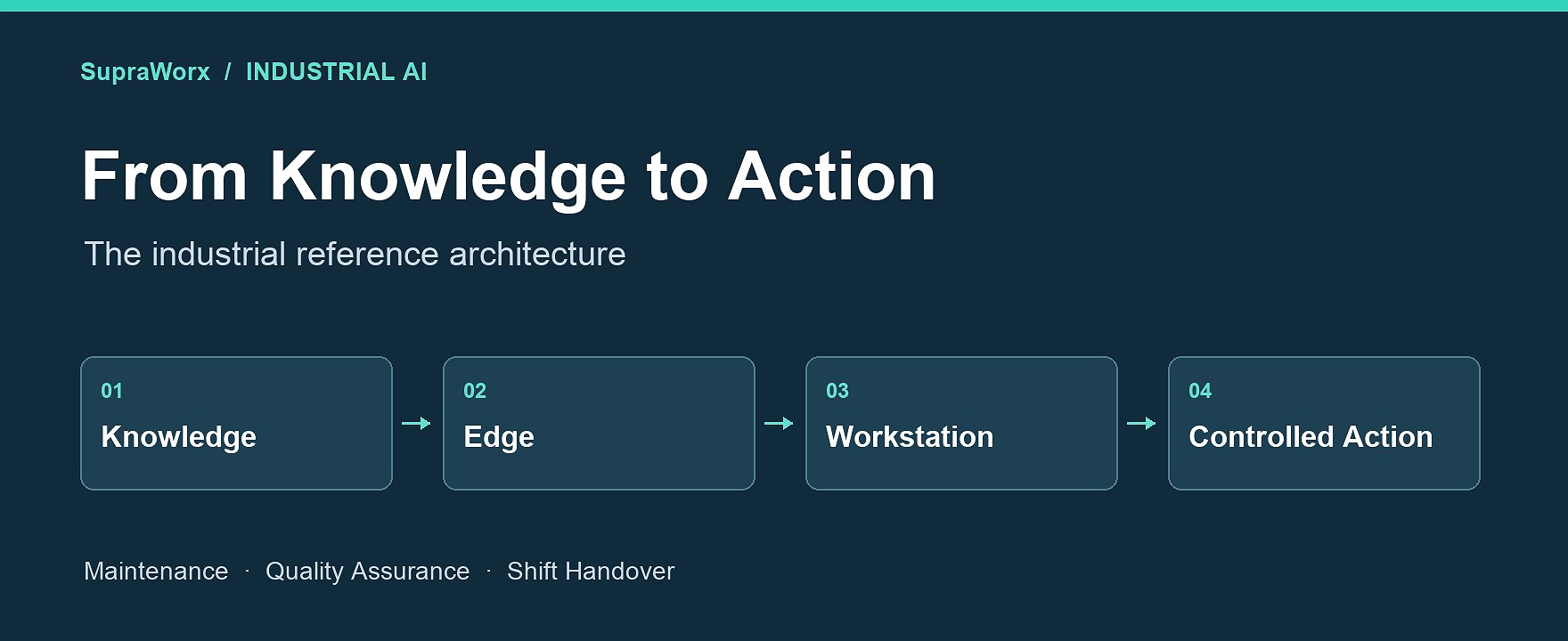
- A compact development and demonstration environment is designed to bring physical equipment and software agents into a shared workflow architecture.
- SupraWorxOS and AINA LabCoBot provide the software and robotics foundations for connecting defined tasks, device actions and documented results.
- The focus is on practical use cases that can be tested in a limited setting before wider deployment.
Dresden, Germany, 21 October 2026. SupraTix is developing a modular agentic mini factory at its Dresden headquarters. The initiative brings together AI agents, robotics and connected equipment in a compact development and demonstration environment. Its purpose is to explore how organisations can turn a defined task into a coordinated workflow across software, machines and people.
The mini factory is designed around reusable capabilities. A robot handles a physical operation, a camera supplies an observation, a sensor reports a condition, and a software service records the result or prepares the next task. AI agents help coordinate these steps within defined permissions and process rules. People set the objectives, review proposed actions and retain responsibility for operational decisions.
Connecting robotics, devices and business workflows
SupraWorxOS provides the modular software foundation. Its AI capabilities include SupraAgent, which can coordinate specialised agents using approved information and connected applications. Shortcuts and controlled interfaces connect events and decisions to defined workflows. Available functions depend on the installed modules, device interfaces and configuration. The underlying SupraWorx architecture supports local AI processing on NVIDIA Jetson hardware, alongside cloud and on-premises deployment options.
AINA LabCoBot contributes SupraTix’s approach to physical automation, combining robotics with cameras, grippers, identification and device data. SupraTix’s Model Hardware Standard framework describes equipment capabilities, operating limits and execution checks, giving software agents a structured way to request approved device actions and receive results.
The architecture accommodates several kinds of participants: software agents, robotic systems, sensors, instruments, other actuators and the people who supervise the process. Each has a defined role. This makes the handover between tasks a central part of the design, from the initial request to the recorded outcome.
From a defined task to a documented result
An illustrative workflow could begin by identifying a component or sample. A camera checks its position, the system requests an approved handling routine, and a connected instrument performs a measurement. The workflow then links the result to the relevant object and process step. A missing prerequisite or an unexpected result would require a defined response, such as pausing the sequence for human review.
This example describes the intended interaction between modules. The specific sequence, equipment and operating limits must be configured and validated for each application. AI planning sits above checked execution: local controllers and protective functions govern physical movement, while permissions and approvals determine which actions may be requested.
A practical starting point for small and midsize businesses
The Dresden initiative is intended to help organisations examine a manageable process before extending automation. Possible starting points include component inspection, sample handling and the documentation that connects a physical task to a digital work order. A pilot should establish which steps are suitable for automation, what information is missing and where expert judgement remains essential.
Useful evaluation criteria include the time required to complete a task, the completeness of its documentation, the frequency of manual corrections and the handling of exceptions. These measurements provide a basis for deciding whether to adapt, extend or stop a particular workflow.
The mini factory is being developed as a setting for this practical evaluation. Each use case will require its own technical validation and acceptance before operational deployment. Companies, research organisations and equipment providers interested in discussing a defined workflow can contact SupraTix.
About SupraTix
SupraTix GmbH is a technology company based in Dresden, Germany. Founded in 2016, it develops software and automation solutions that connect business processes, knowledge, AI and physical systems. Its portfolio includes the SupraWorxOS platform and AINA LabCoBot.
Media and project enquiries
SupraTix GmbH
Ostra-Allee 20, 01067 Dresden, Germany
Email: info@supratix.com
Telephone: +49 351 3394 8400