A maintenance recommendation may be correct for one machine and unsuitable for another. A process description may have passed expert review while still containing information restricted to a particular team. Dependable industrial knowledge therefore needs two answers: Where does it apply, and who may use it?
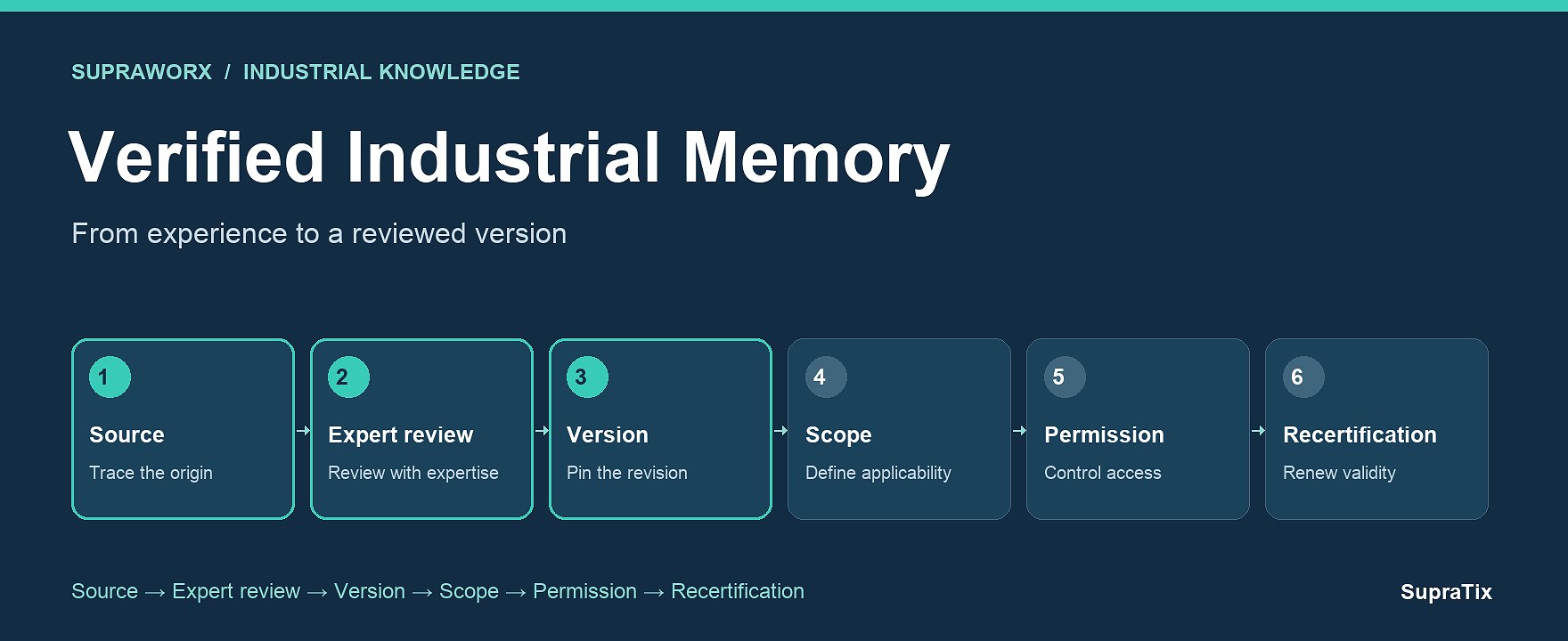
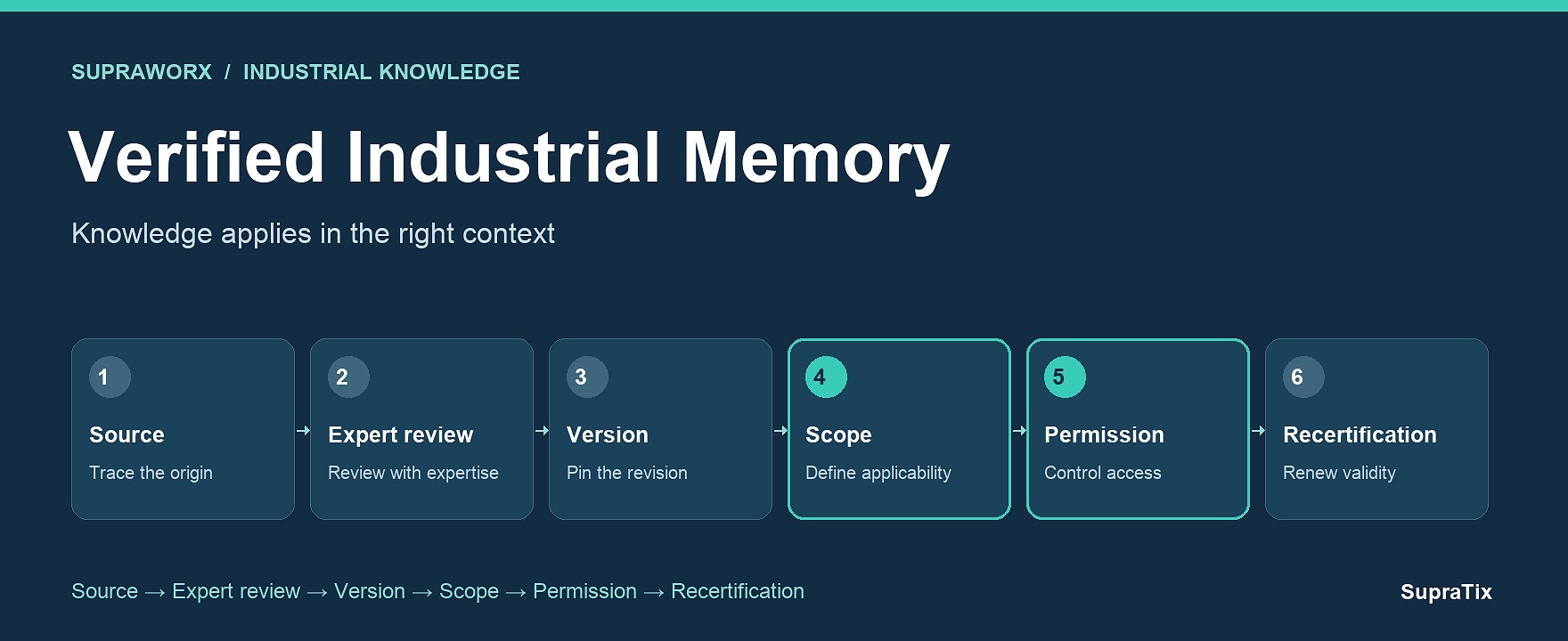
In Verified Industrial Memory, the SupraWorx principle for reviewed operational knowledge, both questions belong to the same trust chain: Source → Expert review → Version → Scope → Permission → Recertification. Scope and access extend content review to cover the actual context of use.
Scope is part of the statement
Consider a fictional example: Two production lines operate similar machines. Line A has introduced an additional check after a tool change. Line B uses a different material combination and a different process sequence. An identical search term does not make the recommendation from Line A applicable to Line B.
A useful scope identifies the technically relevant boundaries. These might include an organization, site, process, machine or particular configuration. The boundaries must be precise enough to determine whether a request falls within them. If that remains uncertain, the uncertainty must be visible.
Similarity does not prove applicability
AI-assisted search is effective at recognizing linguistic and conceptual relationships. Industrial use requires an additional check: Does the information apply in the requested context? A plausible response must not conceal a missing basis for applicability.
The existing SOP release mechanism in SupraWorx uses explicit scopes and time-bounded releases. The underlying principle also makes sense for experiential knowledge: Relevant information needs a traceable relationship to its specific use.
Permission remains a separate condition
Expert approval and access rights answer different questions. A statement may be correct while its source is restricted for the current user. Conversely, permission to read something does not authorize a person to approve its content or execute a process.
Verified Industrial Memory brings these conditions together. Each connected knowledge collection must establish which roles may capture, review and use its content. Source permissions must remain effective. A summary can also disclose confidential information and therefore belongs within the same access-control assessment as its source.
Rights can change
A role change, the end of a project assignment or the withdrawal of source access changes the conditions for use. An earlier review must not permanently replace current access checks. Applications need to check the relevant rights at the point where knowledge is actually provided.
The new Verified Industrial Memory revalidation extension uses current source checks for its own knowledge entries. Its initial implementation keeps access narrow: The owner reads the knowledge entry, while independent experts require separate review permission. Broader distribution needs explicitly governed access paths.
A clear operational starting point
A team can start with one knowledge collection and make four concrete decisions: its technical scope, permitted sources, responsible reviewers and authorized users. It can then test typical boundary cases, such as a request concerning the wrong machine or a user lacking source access.
This makes the security principle visible in everyday work. Employees can identify which recommendation fits their situation. Responsible teams can trace why access was allowed or information was withheld.
Define the scopes and access paths for your industrial knowledge with SupraTix.