
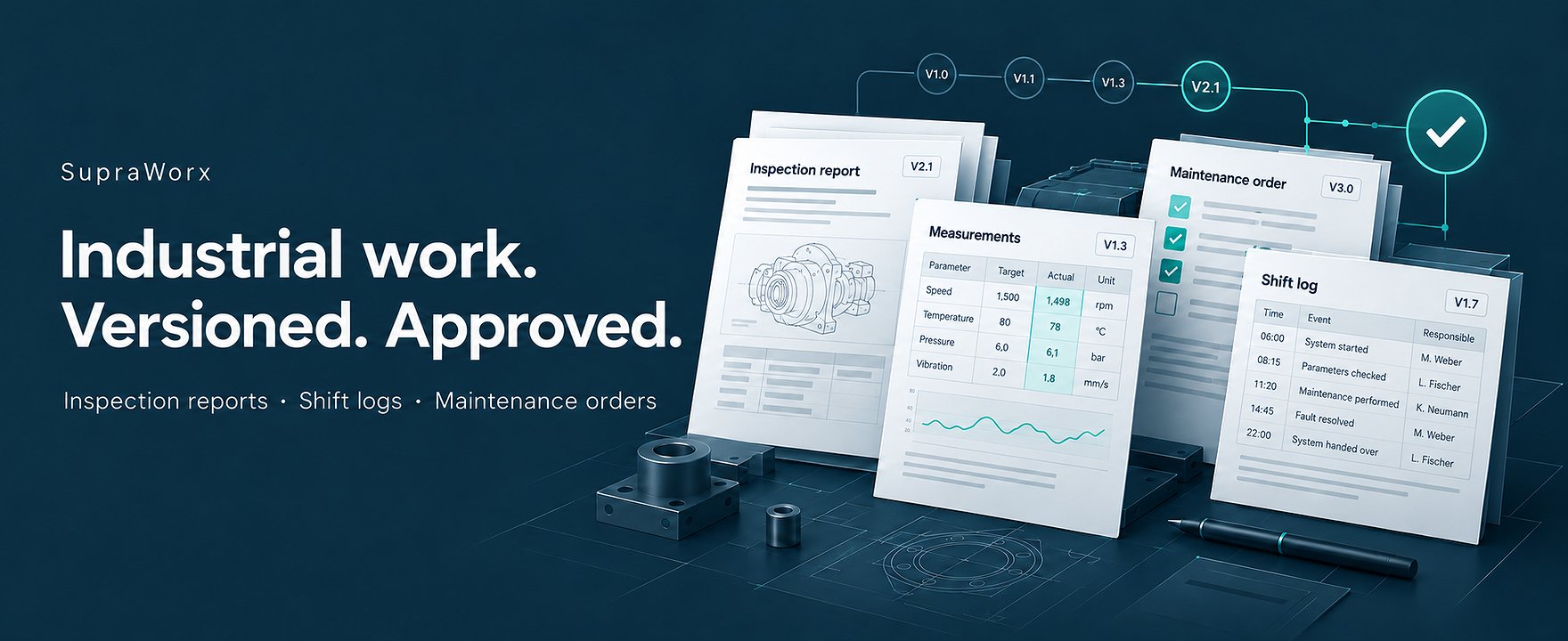
A shift ends, a machine shows unusual behaviour and the next team needs a reliable handover. A conversation with an AI can help organise observations. Continued operation, however, requires a clearly defined work product: a shift log with a machine reference, open issues, sources and a traceable status.
This is the starting point for SupraWorx priority P3: prioritising native industrial artifacts in the workspace. Inspection reports, shift logs, maintenance orders, tables and work instructions should be treated as structured work objects specific to their operational purpose. The classification “medium effort / high impact” describes the qualitative product priority. This article explains the target model and its acceptance criteria; availability of individual capabilities depends on the released product and integration version.
What makes a work artifact native?
A native artifact has its own identity, a defined operational type and structured content. It remains editable, connected to its process and traceable across versions. An exported file can be produced from it, but should not be the only place where responsibility and approval are documented.
The shared underlying model includes a title, object identifier, responsible role, machine or order reference, version, reason for change, sources and approval status. Content changes produce a new version that can be reviewed. Approval applies to exactly that version and its defined scope.
Five artifact types for industrial work
- Inspection report: Inspected object, inspection-plan version, measurements with units, assessment basis, deviations and responsible reviewer. Observation, AI assessment and the responsible professional's decision are presented separately.
- Shift log: Time period, line or machine, events, open measures and handover responsibility. Additions after handover remain visible as changes.
- Maintenance order: Asset, fault description, priority, planned scope, responsibility and completion evidence. An approved order does not automatically authorise every conceivable device action.
- Table: Unambiguous column definitions, units, data provenance and traceable calculations. Input values must be distinguishable from calculated results.
- Work instruction: Scope, prerequisites, professionally reviewed steps and a valid version. An AI-generated revision remains identified as a draft until it receives the required approval.
A shared workspace connects the process
A maintenance order should be able to reference the deviation in an inspection report. The shift log should make outstanding measures visible. The work instruction provides the valid procedure, while a table supplies measurements or analysis. These connections help avoid conflicting copies and make the decision basis discoverable.
A shared workspace still needs differentiated access. Reading, editing, reviewing, approving and executing remain separate permissions. Confidential content is used only in an authorised context. Consistent collaboration does not require blanket visibility of every document.
Version and approval status belong in every relevant view
A suitable status model distinguishes, for example, draft, under review, approved, superseded and withdrawn. Creating a document does not automatically approve it. Nor should the most recently edited version replace the operationally valid version without review.
The interface should show which version is currently valid, who approved it, when, and for what purpose. Changing an approved instruction creates a new version requiring review. The previous version remains historically traceable; whether it stays valid is determined by the process rule. Exports and printouts should carry the object identifier, version and status at the time of export.
Human Approval + Technical Safety Envelope in document processes
The same five security questions remain separate for work artifacts. The action may be creation, modification or approval. Permission determines who may perform it for the specific object. The source substantiates data and statements. The device boundary applies whenever content is to become a real device job. The audit connects the version, decision and actual outcome.
An approved inspection report must therefore not silently start a machine. A recommendation in the report is first treated as a proposal. Only a separate, authorised action process, approved according to its risk, can turn it into an executable job. The technical limits of the target device continue to apply.
Practical example: A quality deviation across two shifts
In a planned application scenario, an unusual measurement leads to a draft inspection report. The quality lead checks the data source and inspection plan and approves a specific version. A maintenance order is then prepared and linked in the shift log. The next team sees the valid report, the open order and the associated approved work instruction.
After maintenance, the result and completion evidence are added. Unresolved or conflicting measurements remain visible. A new assessment does not overwrite the historical finding. This allows later reviewers to understand what information was available at a particular time and how decisions followed from it.
A small pilot with clear acceptance criteria
A recurring process involving a few artifact types is enough to get started. A binding data model, clear roles and verifiable status transitions are decisive. Acceptance should demonstrate that a superseded instruction remains identifiable, that a change is reviewed again and that a missing source record cannot lead unnoticed to approval.
Measurable criteria include time to an approved handover, source completeness, the number of conflicting versions and the traceability of open measures. This makes operational value visible without blanket productivity promises.
Your next step: Bring a typical inspection report, shift log or maintenance order to a discussion with SupraTix. Together, we can shape a bounded SupraWorx workspace with defined versions, roles and approval rules.


